Growing up is never easy – and the young simian in Delphine Dussoubs‘ film Little Monkey isn’t just battling raging hormones, he has a ferocious fire fight to contend with too. Colourful and raw, the shamanic short represents something of a right of passage for director Dussoubs, who has recently graduated from EMCA Angoulême. We caught up with her to find out more.
Where did the story idea for Little Monkey originate from?
A few years ago I thought to do a story about a rite of passage, because I have an admiration for the shamanic rites in different cultures. At first, I wanted to tell the story of a transition to adulthood in an African tribe, but finally I wanted to tell something more universal in tribal and ancestral rites.
The sound design is great and the music reminds me a little of Indonesian Gamelan music. What inspired the music and sound design for the film?
For music, I preferred not to keep a standard coding. I wanted to confront the African djembe sounds with Asian sounds, to lose viewers into origins of the rite, to keep again something universal. I found it nice that the monkey is learning to play djembe by listening all kinds of sounds, even the rain.
I love the bold colours and simple character design – why did you think that this look was the most appropriate? What inspired the character design?
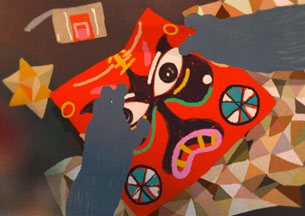
Basically, as an illustrator, this film was for me an excuse to have fun and set in motion what I like to draw: simple shapes, colorful, naive and endearing cute characters but also with full sets details and objects. What I liked as it was to put a touch of absurdity in the nature of some characters such as crabs and birds. All this is possible thanks to the animation.
The story is about a little monkey growing up and coming of age. This is interesting as the film is your graduation film – also a personal coming of age. Did the film have any personal/emotional significance?
Maybe, there is a bit of me in the character of the monkey. I often mimicked his actions, facial expressions, so I’ve still been a part of me in his nature. After that, I don’t think there is an emotional significance, but just the desire to tell a passage of life, that we have all experienced.
Do you remember the moment you decided to become a filmmaker?
Ever since I was young, I have read and told stories, but I also drew them. I did a lot of comics in my bedroom. Making films is, for me, the continuity of it all. And when you love to draw, make pictures, you dream of seeing them come to life. Because of this I decided to begin studies in animation after the baccalaureate (high school).
What inspires you?
This question follows on from the one above, because my main sources of inspiration are also those who gave me the desire to make animated films. I cannot hide that I’m inspired by the world of Masaaki Yuasa (crazy and absurd side, very nice graphics), or even Hayao Miyazaki (endearing and fantastic characters), directors who are really pronounced my mind with their creativity and the beauty of their films.
Aside from Little Monkey, which pieces of work are you proudest of and why?
Little Monkey is my first completed film. Before, I worked on very interesting project like advertisements, or team projects. I made a travel sketchbook on Morocco which had a lot of success. Now that I have finished my studies, I am very excited to be able to create new things. I would like the rest of my projects to use a mix of several techniques (2D, 3D, photography …) and, why not, combine my passion for travel scketchbook with the animation.
To find out more about Delphine Dussoubs and her work, check out her website www.raz-de-marais.blogspot.com